
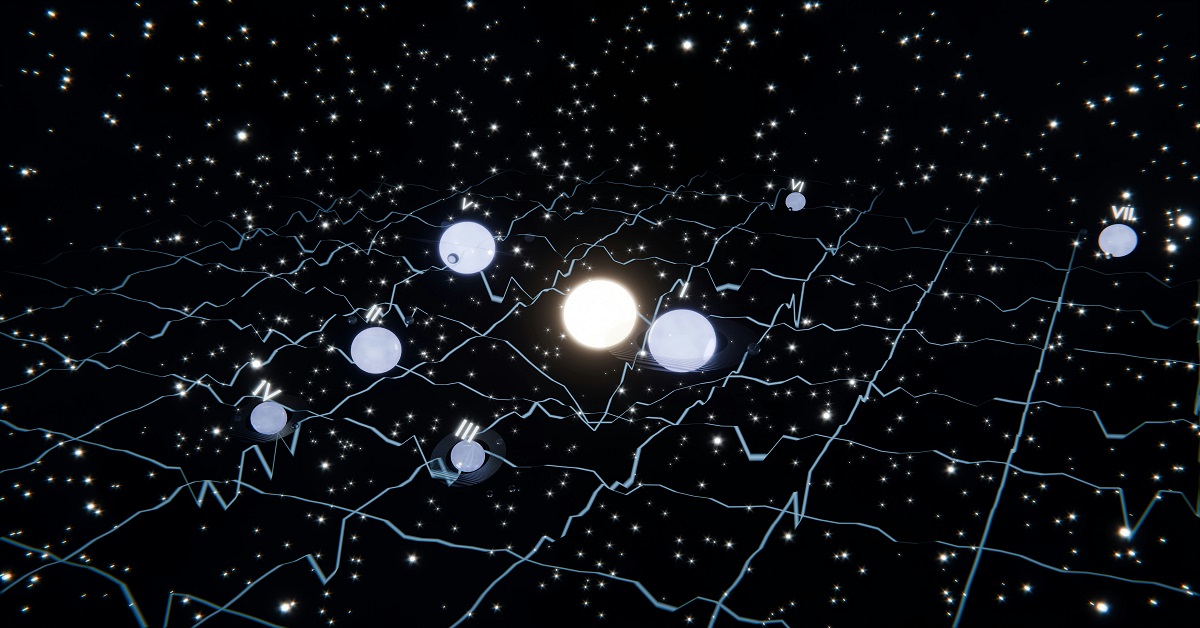
“Curiosity has its own reason for existing. One cannot help but be in awe when one contemplates the mysteries of eternity, of life, of the marvelous structure of reality.” A man of moral values, creative flair, and an ardent learner of the universe’s intricacies, Albert Einstein left a mark on the scientific community alongside renowned physicists and scientists: Niels Bohr, Marie Curie, Werner Heisenberg, Erwin Schrödinger, and others.
From the Theory of Relativity to Quantum Physics, Einstein’s contributions pave the way for further research and development in various fields of science. The discovery of black holes and gravitational waves are notable examples. Even the discarded ‘cosmological constant’ is useful for modern-day cosmologists who relate it to the accelerating expansion of the universe.
Video Link: https://www.youtube.com/watch?v=aNuuYKieHRY
Most of his predictions were backed by logical proof: Leonard Schiff, William Fairbank, and Robert Cannon, in their famous Gravity Probe B experiment, tested the geodetic effect (curvature of space-time around the Green Planet) and the frame-dragging effect (stretching of space-time with Earth’s movement); they found that the direction of the rotating gyroscopes changed exactly as predicted by Einstein’s calculations.
As quoted by Max Born, a German-British mathematician, “For Einstein, physics was philosophy, and he believed that the ultimate goal of science was to uncover the fundamental laws of nature that determine everything.”
EINSTEIN AND NEWTON – A BRIDGE OF DISTINCT IMAGINATIONS
Brian Greene, a famous American physicist, said, “Where Newton saw space as passive, Einstein saw it as dynamic. It’s interwoven with time, and it dictates how things move.”
Isaac Newton and Albert Einstein, two of science’s greatest physicists, were born in different eras, but were enthused by similar aspects of physics such as gravity, space, and motion. Each offered their own theories and predictions on the topics. However, some of Einstein’s viewpoints stood in contradiction to Newton’s theories.
GRAVITY
Newton’s Law of Gravitation was the near-perfect response to centuries-long queries linked to celestial objects’ motions. According to the English scientist, gravity was a force that acted on different masses and various states of matter. Cosmologists and engineers used it to discover Neptune, to determine space shuttle trajectories, the path of comets, and other critical parameters. However, the law couldn’t explain ‘action at a distance’, an anomaly accepted for centuries until Mercury’s eccentricity came into the limelight.
The Swift planet’s trajectory around the Sun was not completely elliptical. A minor angle of 43 arc seconds per century was still left unmeasured, after the effects of gravity were accounted for. Einstein’s calculated predictions, which were confirmed through tests by other physicists in later years, led to the conclusion that space-time, a single continuum, was curved. And the planet followed the path inherently.
CURVED SPACETIME
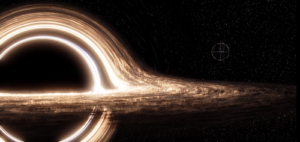
According to General Relativity, an elliptical orbit (Mercury’s path) around a massive body (The Sun) is not perfectly closed. The eclipse rotates slowly because of curved spacetime.
Massive objects alter the geometry of space and the flow of time. A body moves more slowly and experiences various gravitational effects when it is closer to a star, such as the Sun. Likewise, a far-off body undergoes a faster passage of time and less curvature of space-time.
Besides heavy celestial objects, the 4-dimensional continuum is also present in black holes, empty space, and the Green Planet.
“Henceforth space by itself, and time by itself, are doomed to fade away into mere shadows, and only a union of the two will preserve an independent reality.”
Hermann Minkowski
(1908 Address on Space and Time)
THE EQUIVALENCE PRINCIPLE
Einstein’s elevator-thought experiment was the key to understanding spacetime. He imagined two scenarios:
- A person in an enclosed elevator (at rest) on Earth
- A person in an enclosed elevator (accelerating) in Space
In both situations, the person would experience a downward pull. This thought-observation led the German physicist to conclude that gravity and acceleration are equivalent. In other words, gravity is not a force; it is the effect of being in an accelerated frame of reference.
Technically, postulates (a) and (b) are linked to gravitational mass and inertial mass respectively: Both are equal to each other, according to Newton and Einstein.
“It follows that it is impossible to discover by experiment whether a given system of coordinates is accelerated, or whether … the observed effects are due to a gravitational field.”
Albert Einstein
BENDING OF LIGHT

‘Light always follows the straightest path through curved spacetime’, a conclusion derived by Einstein using the elevator-thought experiment. He imagined a beam of light traveling from one end of the accelerating elevator to the opposite end. Due to motion, the beam would strike the wall at a lower point, forming a curved pattern.
As acceleration and gravity were indistinguishable, Einstein concluded that gravity can also bend light. After a series of calculations, he came up with a prediction for light passing through the Sun’s gravitational field. He said, “A ray of light going past the Sun would undergo a deflection of 0.83 second of arc.”
In 1919, Arthur Eddington undertook expeditions to observe a total solar eclipse and verify Einstein’s claim. The British cosmologist stated that astronomers would see a minor shift in the stars’ positions around the Sun due to the bending of light. Photographs of the stars were taken and compared during and after the occultation; the results proved Einstein’s predictions accurately.
According to General Relativity, gravity is the effect of curved spacetime. And light follows that path. Mercury’s anomaly was attributed to the same concept. The unexplained discrepancy (43 arc seconds per century) that kept scientists in search of a new planet (as per Newton’s calculations) was detailed explicitly by Einstein’s theory.
DIVERGENT DISCUSSIONS
Contradictions, improvements, and newfound theories are a vital part of the scientific community. Many professionals have experienced it. Isaac Newton and Albert Einstein, who met at the intellectual crossroads of life, offered different yet profound explanations on various topics.
Newton – “If the Sun were to disappear suddenly, the loss of gravity would act instantly everywhere; the Earth, along with other planets, would feel the drift from the Solar System, all at once.”
Einstein – “Information about any change cannot travel faster than the speed of light. Light takes 8 minutes from the Sun to reach the Earth. If it were to vanish, the Green planet would not know for the same 8 minutes that the Sun has taken another course.”
Newton – “Absolute, true, and mathematical time, of itself and from its own nature, flows equably without relation to anything external”. “Absolute space, in its own nature, without relation to anything external, remains always similar and immovable.”
Einstein – “It is in consequence of this that space and time are welded together into a uniform four-dimensional continuum.”
THE SPECIAL THEORY

From analyzing the mysterious splendor of light to the masterful equation, Albert Einstein developed a newfangled theory in the world of science, using Gedankenexperimente (thought experiments) and deductive/inductive reasoning. The Special Theory of Relativity provides an understanding of bodies at constant velocity and the relation between matter, light, and energy.
LIGHT – THE RELATIVE COMPONENT OF MATTER
At age 16, Einstein visualized a thought experiment, traveling at the speed of light alongside a beam. This experiment became the basis for the Special Theory of Relativity.
Light, as determined by Newton, was a stream of emitted particles. The speed of these particles (photons) was 186,000 miles per second, similar to electromagnetic waves. Einstein, at first, believed that properties of light were analogous to sound waves: Light behaves as a disturbance in an unseen medium, and the relative speeds of the observer and light waves alter with motion.
After several experiments and extensive research, both statements were proved false. The unseen medium (ether) did not exist, and the speed of light was not affected by the source or the observer’s motion. It was the same for a specific medium:
Medium | Speed of Light (km/sec) |
Vacuum | 299,792 |
Air | 299,700 |
Water | 225,408 |
Glass | 197,232 |
It was termed the light postulate. Eventually, Einstein combined it with the principle of relativity. He stated that a stationary or moving observer will experience light in a similar way, i.e., the speed of light will not change.
EFFECTS
TIME IS NOT ABSOLUTE
“An analysis of the concept of time was my solution. Time cannot be absolutely defined, and there is an inseparable relation between time and signal velocity.”
Albert Einstein in conversation with Michele Besso
Einstein’s thought experiment on moving trains was the key to finding the relative nature of time. He imagined that lightning bolts strike the train track’s embankment at two distant places, A and B. If a static observer were exactly halfway between the strikes at the embankment, light would reach him at the same time.
In that instance, a second observer, standing at the midpoint of the train, is aligned with the first observer, who is at the midpoint along the tracks; both would see the lightning bolts strike simultaneously, provided the train is motionless.
However, if the train moved towards the right relative to the embankment, the observer on the vehicle would be closer to point B than to point A. Consequently, he would see the lightning bolts at different times. In other words, the lightning bolt at B would be seen earlier than at A. He would assert that lightning hit at B before A.
Einstein concluded that events, with reference to the embankment and the moving train, were not simultaneous. There is no way to state that the embankment is at rest or the train is in motion. This phenomenon was termed ‘time dilation’.

Video Link: https://www.youtube.com/watch?v=g9p9AfjVMKY
LIGHT, MASS, & ENERGY
“The mass of a body is a measure of its energy content.”
Albert Einstein
According to the German physicist, “If a body emits the energy L in the form of radiation, its mass decreases by L/V2. In other words,
L = mv2
OR
E = mc2
where,
L & E = Energy
m = Mass
v & c = Speed of Light
A kilogram of mass would convert into approximately 25 billion kilowatt hours of electricity.
Einstein wrote a paper for the Annalen der Physik, in which he calculated the properties of two metal pulses emitted in opposite directions by a static body, and the properties of the light pulses observed from a moving frame of reference.
He found the relationship between speed and mass: He stated that mass and energy are different manifestations of the same thing. They possessed a ‘fundamental interchangeability’.
UNIFIED FIELD THEORY
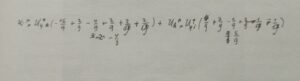
After his astounding contributions to science, Einstein quested for a theory that would combine electricity, magnetism, gravity, and quantum mechanics. He called it the ‘Unified Field Theory’. During his journey, he tried several solutions such as affine theory and distant parallelism, but none came to pass. The box-photon thought experiment also failed to impress.
In a letter to Hermann Weyl, a German mathematician, Einstein asserted the importance of nature in pursuit of a new grand theory. “I believe that, in order to make any real progress, one would again have to find a general principle wrested with Nature.”
Einstein, to the very end, strove for the elusive unified field theory. He used to scribble complex equations, engulfed with cross-outs and corrections on paper. Prior to his demise, a collection of twelve pages were found on his bed.
FUTURE SCIENTIFIC INNOVATIONS
The German physicist’s work is a symbol of high-level intelligence and practicality. Modern technicians, innovators, and scientists have used it for new inventions and sophisticated systems. Some of them are listed below:
- Global Positioning System
- Nuclear Energy
- Solar Panels
- Digital Image Sensors
- Lasers
CHILDHOOD
As a kid, Albert Einstein’s slow development was met with disregard and affronts, especially from teachers. They believed that he was a grave disappointment. Einstein, however, didn’t bother much, and with his distracted mind and rebellious demeanor, kept his focus on lesser-known but essential aspects, such as space and time, gravity, and light. Ultimately, he achieved greatness and stood among the ranks of the intellectuals.
“I very rarely think in words at all. A thought comes, and I may try to express it in words afterwards.”
Albert Einstein
Einstein was a creative genius in the making. At a young age, he worked on puzzles, erected complex structures, played with steam engines, and built houses of cards. The ‘compass’ was one of the most startling objects for him; he believed that deeply hidden aspects were behind things.
“From the very beginning he was inclined to separate himself from children of his own age and to engage in daydreaming and meditative musing.”
Philipp Frank, a scientific colleague of Einstein
His ingenuity knew no bounds. He used to study his textbooks in advance, learn the theorems, and try to prove the new theories by himself. His sister, Maja, recalled, “By age 12, he already had a tendency for solving complicated problems in applied arithmetic”. Furthermore, she added that he would sit alone for days on end, searching for a plausible solution.
The German physicist perceived science from a different perspective. Since childhood, he came up with solutions that mystified others. At the age of 6, he proved the Pythagorean Theorem using the similarity of triangles. Years later, in one of his papers, Einstein stated that Avogadro’s number can be determined by observation with an ordinary microscope.
CONCLUSION
The imaginative intellectual was a staunch follower of classical physics, but negated the existence of quantum mechanics. His colleagues, such as Pauli and Ehrenfest, were upset because of his persistence. However, in the end, he accepted that quantum mechanics is incomplete, not incorrect.
The question is whether quantum mechanics is part of classical physics. One can assume that the underlying constant, irrelevant motion within atoms, ultimately ends up on a macroscopic scale, all intact and steady to the human eye. In other words, the bizarre internal movement shapes the matter that we see, feel, or sense.
ADDITIONAL VIDEO LINKS
Einstein and Special Relativity: https://www.youtube.com/watch?v=gkTVlYDB21g
Arthur Eddington’s Experiment: https://www.youtube.com/watch?v=vF4DENWd_ts
The Elevator Thought Experiment: https://www.youtube.com/watch?v=jx3wcdCtL58
The Enigma of Albert Einstein and Black Holes: https://www.youtube.com/watch?v=QSbpJ3a7qYA